Being the best doesn’t get you found. Being findable does.
Here’s exactly what we check, how the score works, and what lands in your inbox, section by section, before you give us a single detail.
Findability Score
The top of a real report.
Four things decide whether locals find you. Not forty.
The business beating you probably isn’t better than you. It’s just easier for Google, Maps and AI assistants to verify. That comes down to four things, and every one of them can be fixed.
Your Google profile
The listing that decides whether you appear in the map results, where the calls come from.
Your website
Whether it clearly says what you do and where, loads fast on a phone, and can be read by AI.
Your reviews
How many you have, how good they are, and whether new ones keep coming in.
Consistent listings
Your name, address and phone matching everywhere your business shows up online.
Every place your information disagrees with itself is a place an algorithm decides it isn’t sure you’re real.
Sixty seconds from you. About fifteen minutes from us.
Find your business
Start typing your business name and pick it from Google. We pull in your listing, city and website, and you confirm them.
Tell us the search that matters
The one service you most want to be found for, like “emergency plumbing.” We’ll show you the exact search before we run it.
We scan, you get the report
We map your rankings, check your website, listings and AI readiness, and email you a link to your report in about 15 minutes.
One number, four parts. Here’s exactly how it adds up.
One number tells you something’s wrong. Four tell you which thing. Each part is scored on its own, then combined into your Findability Score out of 100.
Core Visibility
35% of your scoreCan people find you on Google Maps right now?
- Map pack visibility across your area20 pts
- Google profile strength14 pts
- Review authority14 pts
- Position against local competitors12 pts
- Review pace (how recently new ones arrive)10 pts
AI Visibility
25% of your scoreCan ChatGPT and Google’s AI read your business and recommend it?
- Structured data (schema)7 pts
- Expertise and trust signals7 pts
- Content structure6 pts
- Answers in plain, conversational language4 pts
- AI crawler access and llms.txt3 pts
- Freshness3 pts
Strategic Readiness
20% of your scoreIs your website built to compete for the things you sell?
- Pages that match what people search for15 pts
- Depth on each service15 pts
- Clear page structure and URLs12 pts
- Saying where you work8 pts
Technical Maturity
20% of your scoreDoes the site work when somebody lands on it?
- Speed and performance (Google Lighthouse)9 pts
- On-page basics9 pts
- Content architecture8 pts
- Clear positioning8 pts
- A clear path to call or book8 pts
- Sites linking to you8 pts
The same four bands apply to each part and to the overall score. If we can’t measure a part (say, you don’t have a website yet), it’s left out and the others are reweighted. It’s never counted as a zero.
What you’ll see, section by section.
Everything below is in the free report, written in plain English: not “improve your SEO,” but the actual page, the actual missing piece, and why it matters. If we can’t measure something (the map, say, when a business isn’t on Google yet), the report tells you instead of guessing.
-
Your map
Where you rank, block by block
“Do I show up?” isn’t one question. You rank differently across town than you do standing in your own office.
So we lay a grid of points across your area, about two miles apart, and run your search from every one of them on Google Maps. Each pin shows where you rank from that spot. You’ll also see how many spots you hold #1, how many you’re in the top three, and how many you don’t show up at all.
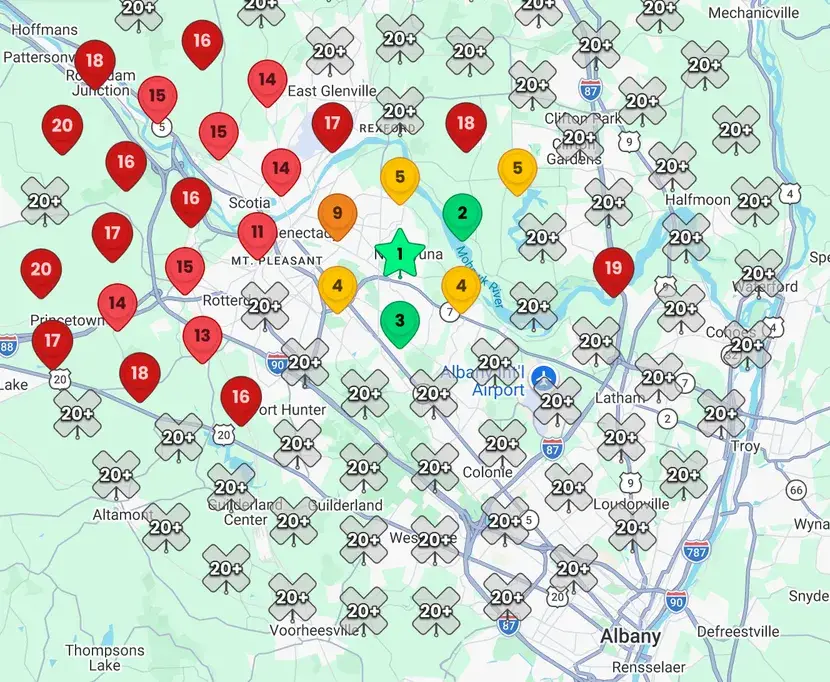
From a real report. 20+ means the business doesn’t show up from that spot. Map data ©2026 Google.
-
Core Visibility
Why the map looks the way it does
Your Core Visibility score, broken into the five things behind it: your Google profile, how much of the map you hold, your review count and rating, how you stack up against the top local competitor, and how recently your last review came in.
Each line gets its own score and a one-line reason, so you can see which one is dragging you down.
Map pack visibilityGoogle profile strengthReview authorityCompetitive positionReview paceIllustration, not a real business.
-
Your 3 critical gaps
The specific things standing between you and the top
Three gaps, pulled from everything we scanned and written for your business. They’re the ones most likely to be costing you calls right now.
No service page for your main searchCriticalBusiness hours missing on GoogleCriticalNo new reviews in 6 monthsHighIllustration. Your gaps will be specific to you.
-
AI Visibility
Can AI assistants vouch for you?
When somebody asks ChatGPT who to call, one name comes back, not ten. To be that name, the AI has to be able to read your business and trust it.
You’ll see all six AI pillars scored, with your two weakest explained. If your website blocks the AI crawlers (GPTBot, ClaudeBot, PerplexityBot or Google’s AI crawler), the report flags it at the very top.
Structured dataExpertise and trustContent structureConversational answersAI crawler accessFreshnessIllustration, not a real business.
-
Strategy and website
Your site, seen the way a competitor sees it
Strategic Readiness: what you have a page for, what you’re missing, and whether you ever say where you work. A lot of local businesses don’t.
Technical Maturity: the wiring. How fast you load on a phone (measured with Google Lighthouse), who links to you, and whether there’s a clear way to call or book. Each one comes with its single biggest gap called out.
Biggest strategic gapCalled outBiggest technical gapCalled outMobile speed (Lighthouse)MeasuredAccessibility checkWhen available -
Competitive snapshot
You, next to the businesses beating you
Not a list we made up. The rivals come from your own map: the businesses that showed up most across your grid. You’ll see their rating, review count, average map position and how many spots they rank #1, next to yours.
This is the section people stare at. It’s usually where it clicks that the business beating them isn’t better. It’s just easier to find.
Business Rating Reviews Avg rank You 4.9 38 11.4 Rival A 4.6 212 2.1 Rival B 4.7 147 3.8 Rival C 4.4 96 5.2 Illustration, not real businesses.
-
Your listings
Does the internet agree about who you are?
We check the directories that matter for your business and count how many show your name, address and phone number correctly, and which ones you’re missing. Most of those listings are free to fix.
Directories checkedCountedName, address, phone correctX of YMissing or wrongListed -
3 quick wins
Three things you can do this week
We don’t leave you sitting with a problem. Every report ends with three fixes, in order, in plain language. Not a six-month plan. Three things you can hand to whoever does your website on Monday.
1The fix that moves the map most2The fix that closes your biggest gap3The quickest trust win
Live checks, not guesses.
Your score is built from a live scan of your business on the day you run it.
Good to know.
Is it really free?
Yes. Everything on this page is in the free report. There’s nothing to buy, and you don’t have to talk to anybody unless you want to.
How long does it take?
About sixty seconds to fill in. Your report is emailed in about fifteen minutes. If you don’t see it, check your spam folder.
What do I need to fill in?
Your business (pick it from Google, or enter it by hand), your website, the one service you most want to be found for, your email, and a mobile number. If you don’t have a website yet, just tick the box.
Why one service?
The map is built from one real search. Use the service that matters most to your business. If you want other services looked at, we can cover them on a strategy call.
Why do you ask for my phone number?
So we can text or call you about your report. You can reply STOP at any time.
What happens after I get it?
That’s up to you. Fix things yourself with the three quick wins, hand the report to whoever does your website, or book a free strategy call and we’ll walk you through it.
I already ran one. Can I run it again?
If you run it again with the same email within 14 days, we’ll resend the report you already have. After that, a fresh scan runs.
See where you really show up, and why.
Worst case, you find out you’re in better shape than you thought.
Rather talk it through? Book a free strategy call →